
How to switch health insurance in Switzerland
"Hey, is it worth raising my deductible to CHF 2,500?"
"Do you go to the doctor much?"
"No, not really."
"Then do it."
"And which model?"
Was dich in diesem Beitrag erwartet
Key points
- Your compulsory basic health insurance (KVG, LAMal in French) must be cancelled by 30 November
- Switching can save you several hundred francs a year
- Priminfo is the fairest comparison platform
Health insurance is one of the more painful fixed costs for anyone living in Switzerland. To be fair, I am glad we have it, but the monthly bill still hurts. Today I want to show you how easy it is to switch health insurer. You have until 30 November to do it. By then, your cancellation must have reached your insurer.
Basic insurance vs supplementary insurance
Swiss health insurance distinguishes between compulsory basic insurance (KVG) and supplementary insurance (VVG).
Supplementary insurance can differ a lot, both in cover and in price. You usually cannot cancel it for this year anymore either: the deadline was 30 September. Switching here is not worth it every year. Premiums are fairly stable, and you always have to fill in a health questionnaire.
If you want semi-private or even private hospital cover, you should sort it out in your thirties at the latest. Later it gets harder and harder, and eventually impossible, to get this cover.
Why you should switch health insurer
With basic insurance, the benefits are always exactly the same. At most, insurers differ in when they reimburse your costs. That is why it makes perfect sense to compare health insurers every year, and possibly switch.
Even though it makes sense for you personally, it is surely also one reason why premiums go up every year. All this admin costs the insurers money too. A pity that, as an individual, you are practically forced to play along.
By switching your basic insurance, you can save several hundred francs a year. It depends on which insurer you are with now and which one you switch to. Let us put it to the test on https://www.priminfo.admin.ch/de/praemien (available in German, French and Italian).
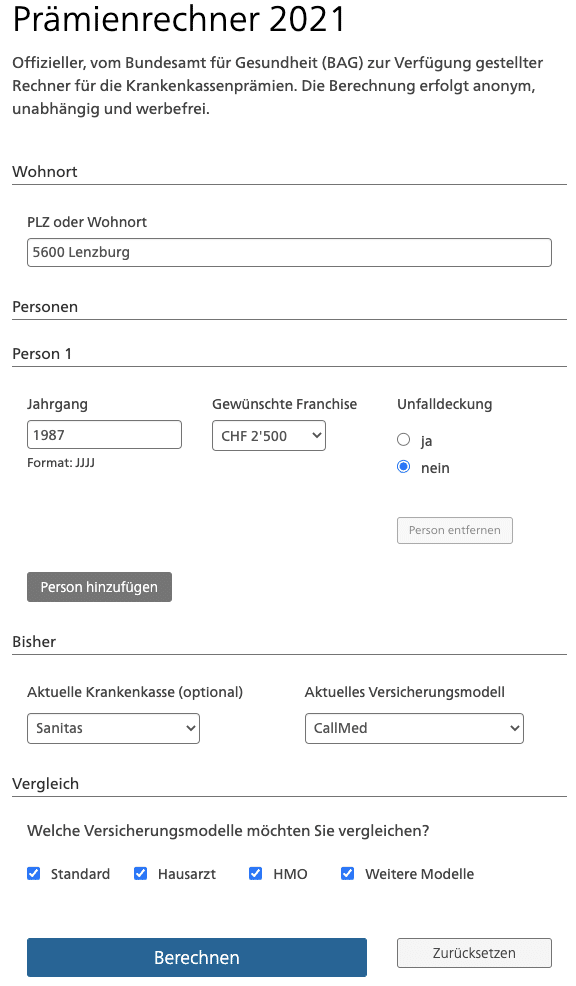
That is all you need to enter. Priminfo does the rest. Unlike Comparis and co., Priminfo is independent.
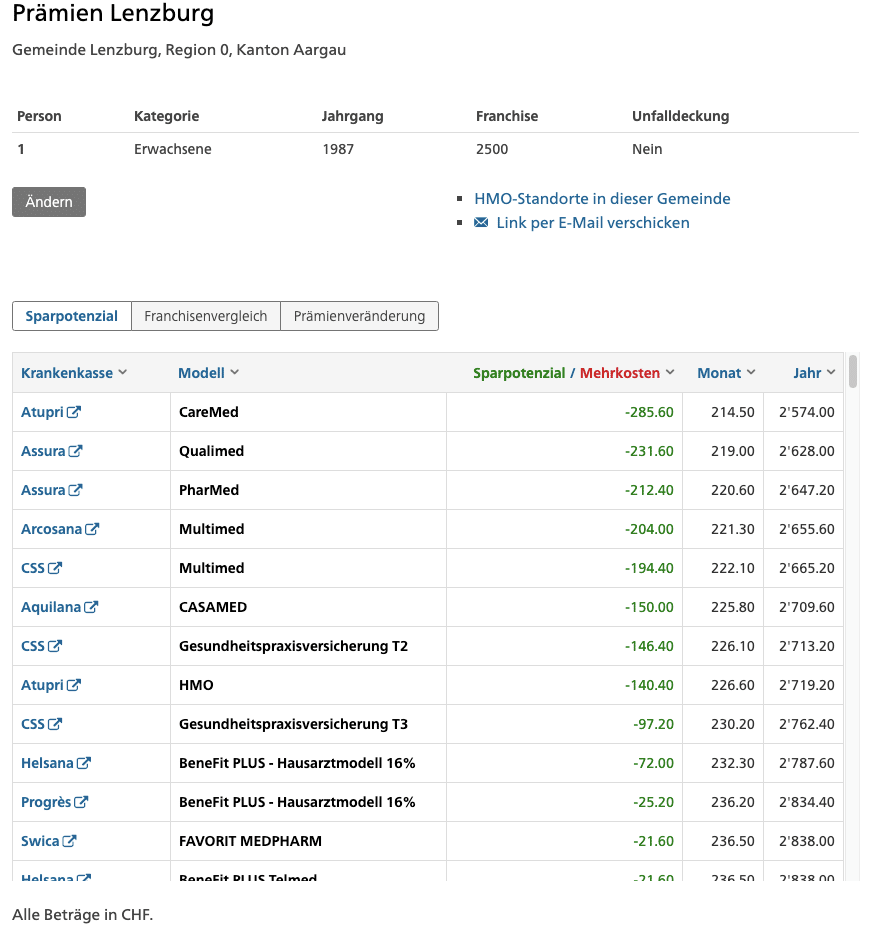
As you can see, I could save around CHF 25 a month myself. Enough to pay for my Netflix subscription and buy a kebab every month. Or even better, I invest the money in an ETF.
Deductible (franchise)
As you can see, you can choose how high your deductible should be. The higher the deductible, the lower your monthly premium. In principle, it is either/or: either you go for a deductible of CHF 300 a year, or straight for CHF 2,500.
The deductible is the amount you pay towards your own healthcare costs each year. Until you reach it, your health insurer pays nothing. Rule of thumb: if your healthcare costs are below CHF 2,000 a year, take the highest deductible. Ideally, though, you should have CHF 2,500 set aside.
With a deductible of CHF 300, the monthly premium is very high. Still, this deductible pays off for people who see a doctor often. Exactly how much premium you save only shows in a direct comparison. But for a rough idea, calculate it like this: (deductible - 300) x 0.7 / 12
(CHF 2,500 - CHF 300) x 0.7 / 12 = CHF 128.33 a month.

Co-payment (Selbstbehalt)
The co-payment is always 10% of your healthcare costs. That covers doctor visits and all medicines and therapies paid for by basic insurance. But it is capped at CHF 700 a year. So you will pay at most CHF 3,200 a year (deductible plus co-payment) towards your healthcare costs yourself.
Standard, family doctor, telemedicine and other models
Another trick to save on premiums is choosing one of the alternative insurance models.
Telemedicine (Telmed)
Personally, I have been a fan of the telemedicine model for years. In short, it works like this: whenever you feel unwell, you always call your health insurer first. Depending on the case, they send you to a doctor or make a diagnosis right on the phone. You get prescriptions and doctor's notes by email. So you do not even have to leave the house for a doctor's note.
Family doctor model (Hausarztmodell)
The family doctor model is simple. You always have to see your GP first before you rush off to a specialist. Personally, I find it an unnecessary detour that drives up Switzerland's total healthcare costs. But I hope they had their reasons.
Standard
With the standard model, probably the most expensive option, you can do whatever you like. Since I am really very rarely ill, I am happy to accept a restriction in return for lower premiums.
I hope this mix of theory and practice helps you switch health insurer and save a lot of money. Especially for families, it can make a noticeable difference, month after month.
See you soon,
FinanzFabio

FinanzFabio wants to use financial education on his blog to save Switzerland from poverty in old age. He no longer believes in the AHV, the Swiss state pension.
PS: Please leave me a heart, just click below. And it would be cool if you told me in the comments how much you will save on health insurance every month next year.
Diesen Beitrag auf Deutsch lesen: Krankenkasse wechseln
Pension Check 65
Retiring in Switzerland?
65 points to tick off before you retire: pension fund buy-ins, pillar 3a, lump sum or pension, taxes. The checklist from 20 years of Swiss financial planning.
Get the checklistPDF in English, CHF 65, instant download